September 14, 2026
Can Gradient's Shooting Grade Predict Next Season's Finishing?
Case Studies


Gradient Player Grades are a new measure to evaluate player performance, purely focusing on execution level. Every shot attempted is manually graded on a scale from -2 to +2 in 0.5 increments, which is then normalised to a 0-100 score. Alongside each raw grade, Gradient captures hundreds of additional contextual data points through event and broadcast tracking data. This allows us to understand the specific circumstances in which each action occurs and adjust grades accordingly. For example, a ground shot is typically easier to execute than a shot on the half-volley. As a result, a half-volley shot may receive a small positive adjustment.
In order to validate any new measure, one must hold it against existing ones to see how it compares; not only on a descriptive level, but more so to see if it adds predictive power.
So let’s take a standard shooting metric: Goals per xG, a measure of how many goals a player scores relative to how many an average finisher would be expected to score from the same shots, based on each attempt's distance, angle, and shot type. We line it up directly against Gradient's Shooting Grades for centre-forwards in the top five European competitions, at least 900 minutes and 30 shot attempts, one dot per player-season. The two move together (correlation of 0.535), but loosely. The players where they disagree are the interesting ones.
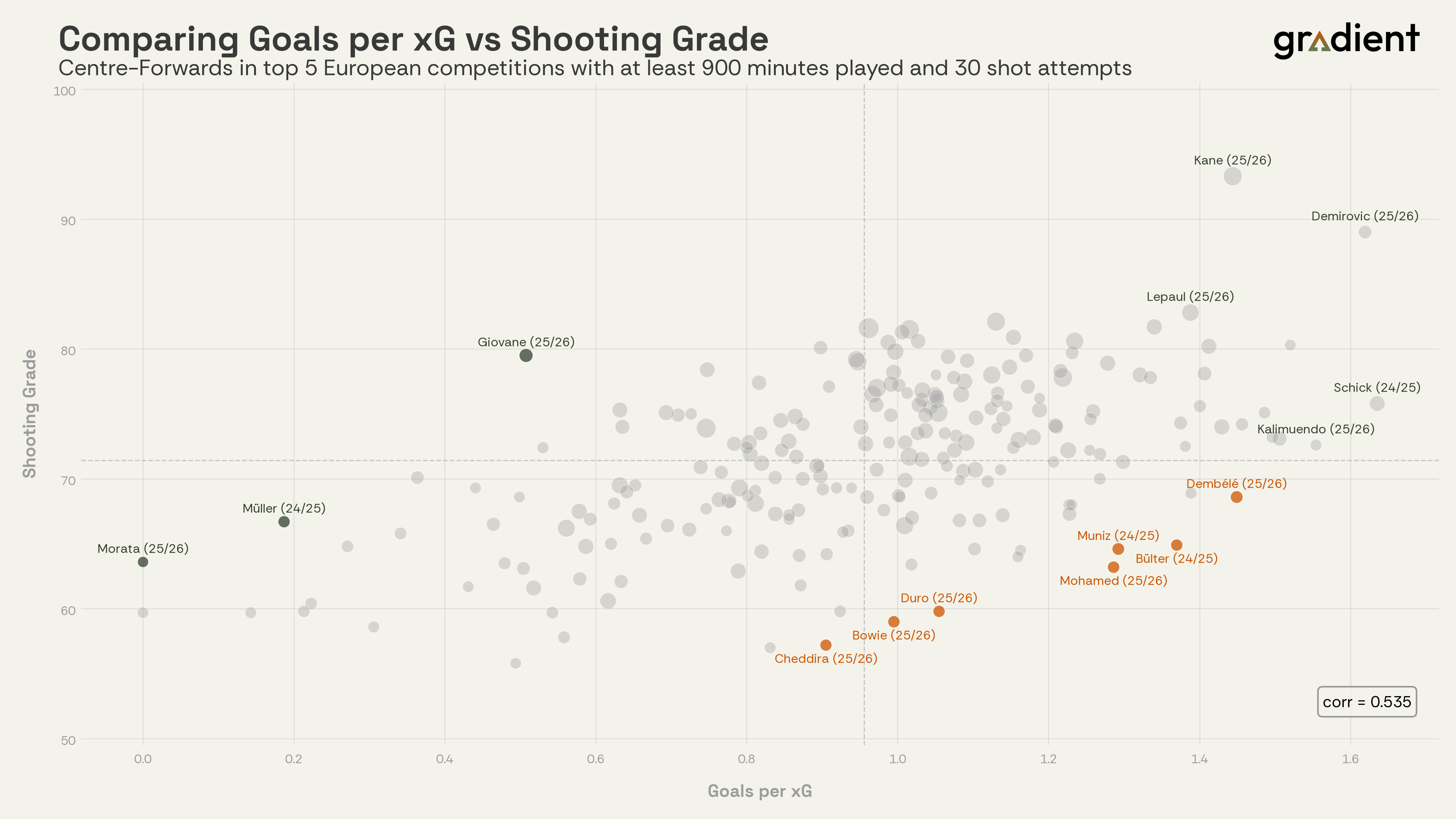
For example, Ousmane Dembélé outperformed his expected goals without grading as well on his shot execution in 2025-2026. The 2025 Ballon d'Or winner is sitting well above 1.0 Goals per xG while only grading in the high-60s. His shots are going in, but his grade doesn’t convince us it's down to how he's shooting. Giovane runs the opposite way: he grades well (high 70s), yet sits at only 0.5 Goals per xG. He executes well when shooting, but it hasn't translated to goals yet.
If the Shooting Grade were just another measure of outcome, it would sit right on top of Goals per xG. The gap we see is either noise, or it's the grade capturing something real about a player's shooting that the outcome doesn’t show. The disagreement is interesting to investigate further, but it's not proof of anything. So the real question is if players who graded well for shooting last season actually finish above their expected goals the next season? If the grade captures real finishing skill, it shouldn't just describe the past, it should predict the future. That's the bar a grading system has to clear before anyone should trust it for recruitment or player evaluation.
How We Tested It
To check whether the Shooting Grade is actually adding something or just repackaging what we already know, we ran two versions of the same test on the same population consisting of Premier League and Bundesliga players with at least 30 shots in both 2024-2025 and 2025-2026.
Test 1: Rank players by their average shooting grade in 2024-2025, split into five quintiles, then measure each quintile's Goals per xG in 2025-2026.
Test 2: Same population, same quintile split, but rank by 2024-2025 Goals per xG instead of the grade.
If a player's raw finishing last season predicts this season just as well as the grade does, the grade isn't worth adding to existing player evaluations methods. In other words, if Test 2 performs similar or better than Test 1, grades can take a backseat and let Goals per xG do the talking.
What The Results Showed
Test 1, the grade-based split, holds up: Goals per xG rose in a clean, monotonic step from the lowest-graded quintile to the highest:
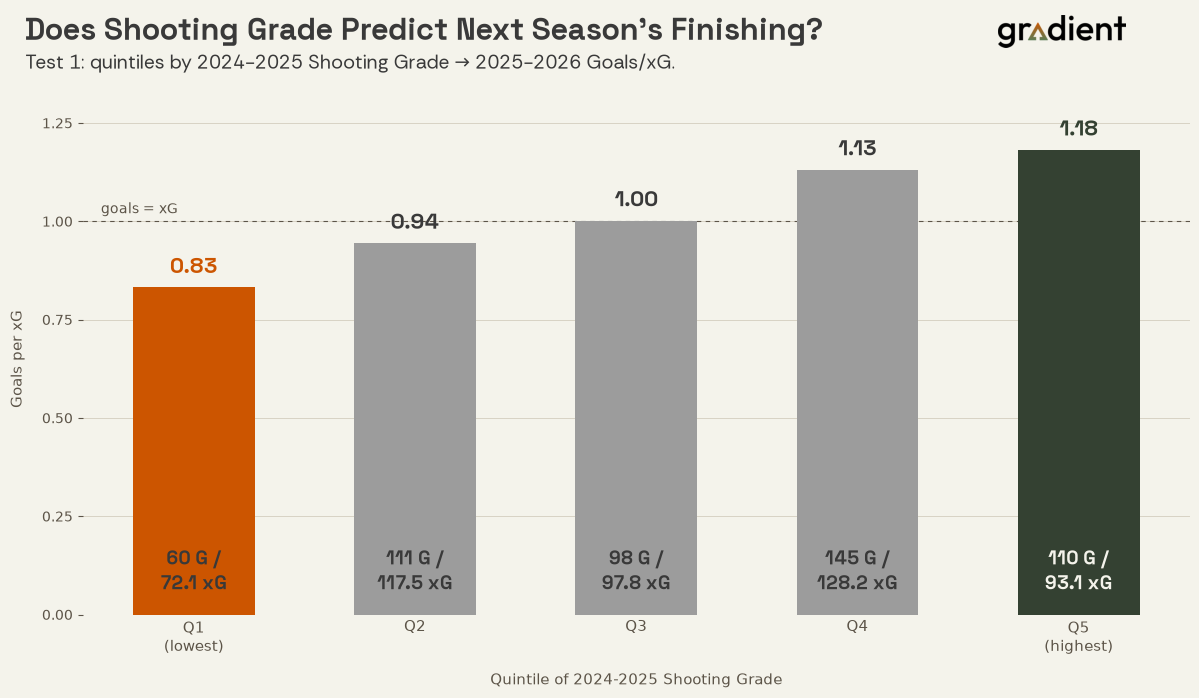
Players graded highest for shooting execution in 2024-2025 outperformed their expected goals by 18% the following season. Players graded lowest underperformed by 17%: a 35-percentage-point spread between the top and bottom groups, generated entirely from a measure that never touched the new season's data.
Test 2, based on the same population, same season split, but quintiled by 2024-25 Goals per xG instead of the grade, looks different:
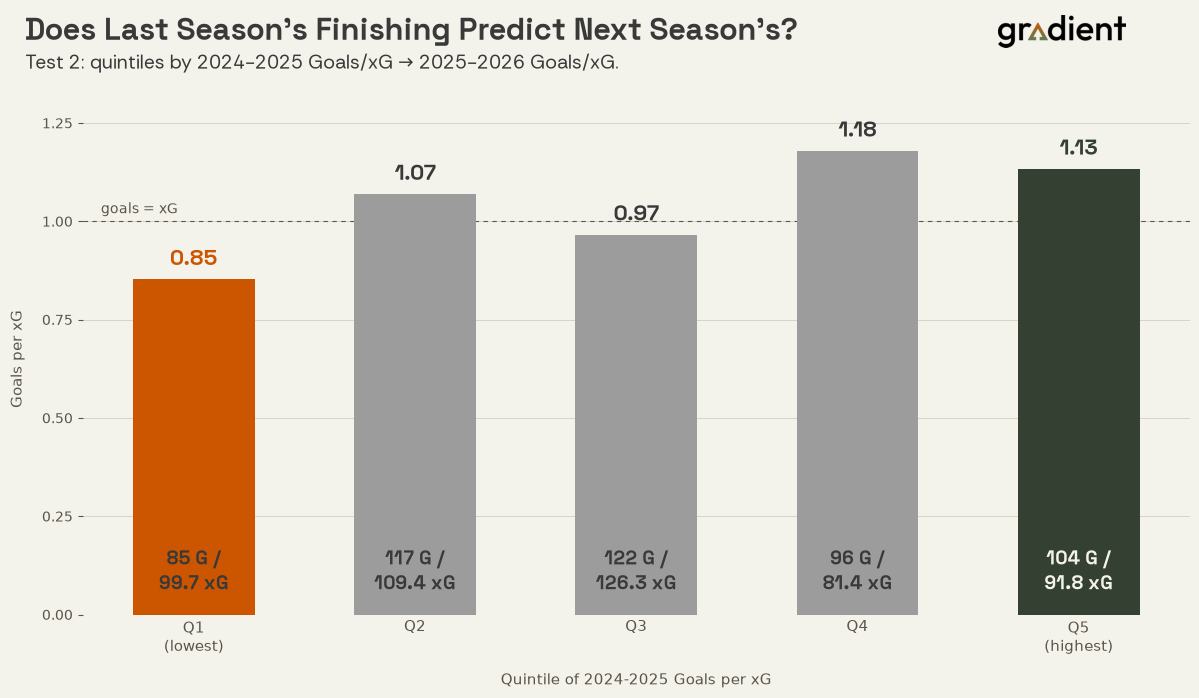
No monotonic staircase: Q2 beats Q3, Q4 beats Q5. Ranking players by how well they finished last season is a noticeably worse predictor of how they'll finish this season than ranking them by how well they executed.
As it turns out, the Shooting Grades are not repeating what outcomes already do on their own. It's picking up something outcomes miss, highlighting their value as an additional measure of performance. A new tool that helps us make more informed decisions when evaluating players.
How Much Can We Trust This?
Our population is based on two seasons from two competitions, leading to a small number of observations (59 players). Splitting them into five quintiles is roughly 12 players per group, which is small enough that a single lucky or unlucky season for a couple of players could swing the result significantly. Before trusting the 35-percentage-point spread in Test 1, we checked how much of it could just be noise.
We resampled the 59 players with replacement, rebuilt the quintiles, and recomputed both ratios 5,000 times (a method called bootstrapping), giving a distribution for the Q5-minus-Q1 spread in each test rather than a single point estimate. For Test 1, the grade-based split, that spread has a 95% confidence interval of [0.02, 0.58]. A relatively wide spread, but importantly it doesn't cross zero. This means the top-graded group genuinely outperforms the bottom-graded group next season, a real effect rather than an artifact of one good sample. For Test 2, the Goals/xG-based split, the spread's 95% CI is [−0.09, 0.56], which does cross zero. So we can't say with confidence that ranking players by last season's raw finishing predicts anything about next season at all.
Our sample size will grow significantly as our coverage expands, and we'll absolutely revisit this test once it does to see whether the effect holds up and the confidence intervals tighten.
Predicting 2026-2027
To predict who will outperform their xG in 2026-2027, we apply the same logic and rank players by their Shooting Grade from the 2025-2026. The top quintile, now consisting of 23 players because of our increased coverage, is the group we'd expect to beat their xG over the season now underway
The top five players we expect to outperform their xG this season: Ermedin Demirović (VfB Stuttgart), Michael Olise (FC Bayern), Eli Kroupi (AFC Bournemouth), Harry Kane (FC Bayern), and Chris Führich (VfB Stuttgart).
.png)
Kane's presence is no surprise. He was already in last year's Q5 group off the back of his 2024-2025 Shooting Grade, and he outperformed his xG again in 2025-2026, recording an incredible 99.9 Shooting Grade, which ranked 1st among all players we collected.
Two names further down the list are worth a second look, for reasons that have nothing to do with the data itself. Richarlison graded well for shot execution (including a rare +2.0 finish against Arsenal) but isn't part of Tottenham's Premier League squad this season. Yan Diomande earned a move to Real Madrid off an excellent year at RB Leipzig, yet Mourinho has only used him as a substitute through LaLiga's first four rounds. Good grades, but no minutes yet to prove them right.
It is worth repeating the caveat from Test 1: 69% directional accuracy is a real signal, not a guarantee for any individual player. Treat this as a shortlist to watch, not a prediction to bet on.